

KEMBER presents Celtic music from Brittany in conversation with sounds from India and West Africa. Think a bit of the Pogues and a healthy dose of Alan Stivell, with Breton melodies and lyrics, spiced with ragas and Mandingo drumming. Alex Martin: guitar, bouzouki, vocals; Ted Porter: mandolin, flutes, and bagpipes; Jodi Beder: cello; Deepak Shenoy: nevhaat (Hindustani synthesizer), vocal tabla; Sachin Kandhari: acoustic fretless bass guitar; Uasuf Gueye: djembe.
Our sets mix instrumental Breton dance melodies with songs in Breton, a Celtic language that is a sister of Welsh and a cousin of Irish and Scottish Gaelic. Most of these melodies and lyrics are hundreds of years old. In the eclectic and cross-cultural spirit that characterizes much contemporary Breton music, our arrangements seek to infuse and renew them with accents from other traditions that the members of our group represent. The result is an energetic, sometimes fiery blend as suitable for dancing as it is for listening.
“Cost ‘er What?” live:

Kember means “confluence” in the Breton language. We chose this name as a nod to the various cultural and musical currents that flow together in our music. It also alludes to Quimper (“Kemper” in Breton), a city in southwestern Brittany where several rivers come together and from which Alex's maternal family hails.
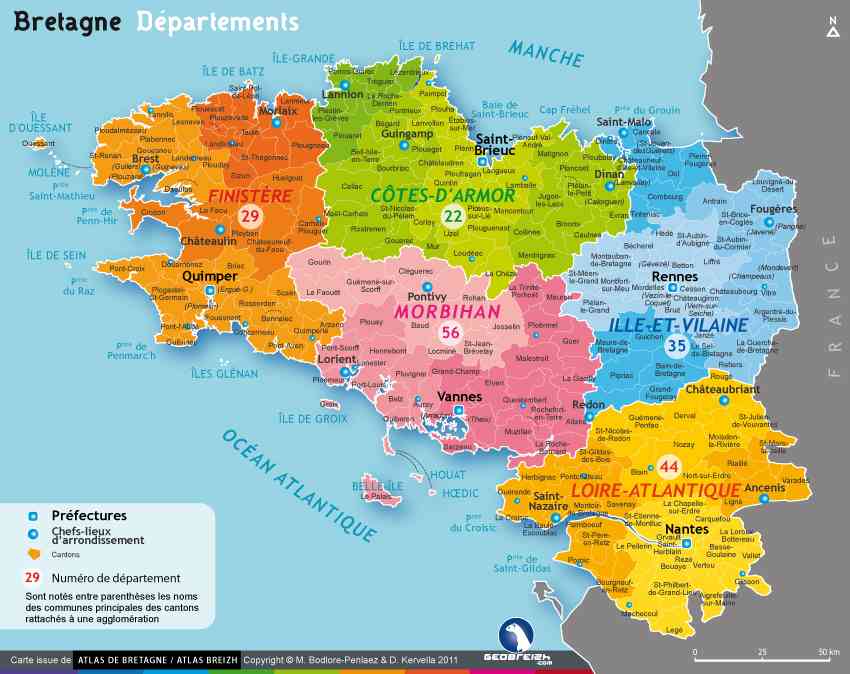
Brittany (Bretagne in French, Breizh in Breton) is the westernmost region of France, forming a peninsula that extends into the Atlantic Ocean. Until its annexation by France in 1532, it was an independent country. It has a strong Celtic identity, similar to those of Ireland, Scotland, Wales, Cornwall, the Isle of Man, and Galicia (in Spain). Much of the population is descended from Welsh and Cornish immigrants who came to Brittany in the fifth and sixth centuries CE, fleeing famine, overpopulation, and Anglo-Saxon raiders.
Brittany is historically bilingual. These days everyone speaks French, but in earlier centuries, the western half of the peninsula (Breizh Izel, or “Lower Brittany”) spoke the Celtic Breton language and the eastern half (Breizh Uhel, or “Upper Brittany”) spoke Gallo, a Romance language closer to today’s French. The Celtic language has suffered under concerted efforts by the French central government to suppress regional cultures, perceived as threats to a unified national republican identity (but tolerated to a limited and superficial extent if they can attract tourists). Still spoken by about 100,000 people, it appears throughout the region in place names and on road signs and can be heard in some regional radio and television programs. It continues to thrive in Breton music.
Breton music was at the core of a cultural revival that fully bloomed in the 1970s. Its most famous exponent was (and remains) the harper and vocalist Alan Stivell, who blended traditional Breton folk melodies and lyrics first with rock, then with the music of other Celtic countries, and continuing to expand out in his collaborations with African and other “world” musicians. Musicians like the vocalist and clarinetist Erik Marchand heard sympathies between Breton music (somewhat more “bent” than its Irish and Scottish cousins) and music from Eastern Europe and the Middle East, recording with Romanian gypsies and Iraqi oud masters. The vocal virtuoso Denez Prigent has blended the Breton tradition of gwerz (plaintive historical ballads) with electronica and trance. Breton music has diversity in its DNA.
Ankou: The Breton grim reaper. He wanders the countryside with his tired old donkey pulling a cart with very squeaky wheels. If you hear that squeak, someone in your entourage will be transitioning soon, their earthly form hauled away in that donkey cart. The Ankou wears the traditional Breton male costume: a dark vest and a very wide-brimmed black hat. He carries a scythe that is always pointed backward. Unlike the Grim Reaper, he is not a stranger. He is the last person from the community who died the previous year.
Biniou (“bee-NEW”): The Breton bagpipe.
Breizh (“braise”): “Brittany” in Breton.
Demat (“day-MAHT”): Literally, “day good,” this is a modern way of saying hello, although traditionally Bretons tended to greet each other just by commenting on the weather (Brav eo an amzer! [“bra-oo eh an amzer”—“Lovely is the weather”/“Nice day, isn’t it?”] or Tomm eo an heol [“tom eh ah nehol”—“Hot is the sun”/“Hot enough for ya?”]).
Far: A Breton custard cake, which Alex likes to make with rum and prunes.
Fest noz: Literally, “party night,” plural festoù noz. These happen every weekend in community centers and other gathering spots all over Brittany. Musicians play, folks of all ages dance the traditional dances, and often impressive quantities of sistr (hard cider) are consumed. The tradition comes from the countryside, where festoù noz culminated a week of hard work in the fields. They often took place in barnyards, with the musicians sitting or standing on cider kegs.
Kamarad: Friend.
Kenavo: Literally, “until will see.” It means “Bye” or au revoir and plays role in the culture is similar to that of aloha for Hawaiians. It’s one word every Breton knows, even if their family stopped speaking Breton generations ago.
Korrigan: Brittany’s version of a leprechaun, but not to be confused with the cutesies on a box of Lucky Charms. Diminutive, yes, but also surly and mischievous. If you meet a korrigan, consider him armed with magic and potentially dangerous. Or he might help you — depends on his whim at the moment. Possibly bipolar.
Kouign amann (“queen ya-MAHN”): Literally, “cake of butter.” A very sweet Breton pastry not necessarily recommended for those with cardiovascular concerns.
Paotr (“poht”): Guy.
Pardon: A Breton religious procession in honor of a saint, culminating in a festival in a churchyard. KEMBER plays the song “Pardon Spezed,” in which we learn that not everything that happens at a pardon is of a strictly religious nature.
Penaos ’mañ ar bed? (“pay-NAH-ous mah ar bed”): “How is the world”/“How are you doing”?
Penn ar Bed: “Head of the world”/“Headland.” This is the Breton name of Finistère, the westernmost department of Brittany. Quimper is its capital/administrative seat.
Plac’h (the c’h is pronounced like the ch in the Scottish loch or the j in the Spanish jalapeño): Gal.
Son: Song, also the imperative form of the verb sonañ, meaning “to play” (an instrument) or “to ring” (a bell).
Soner: Musician.
Trugarez (“true-GAH-ray”): Literally, “mercy” or “forgiveness,” this is a somewhat elegant way to say “Thank you.” Many Bretons also say mersi, borrowed from the French.
Names of some Breton dances:
an dro (literally, “the turn”)
dañs plinn (“flat dance”)
hanter dro (“half turn”)
jabadão ("zha-ba-DOW," a fun word to say, but just the name of the dance)
kas a barc’h (“toss to the inside”)
kost ar c’hoat (“near the woods,” also the name of a Breton subregion where the dance originated)